
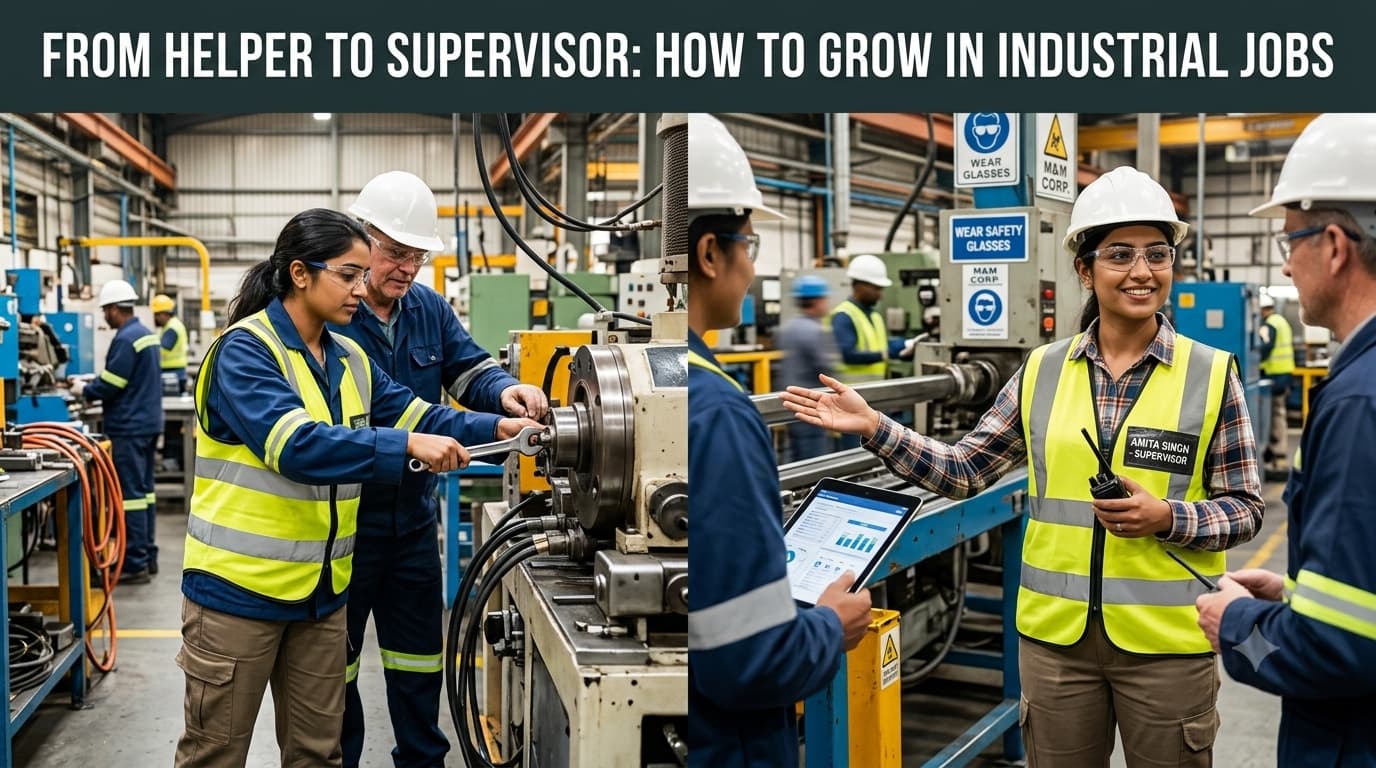
From Helper to Supervisor: How to Grow in Industrial Jobs
WorkMithra Team · 9/19/2026
Most supervisors on a factory floor, warehouse dock or construction site did not start in the manager's chair. They began by carrying material, holding tools and watching how skilled people worked. If you are starting out in industrial jobs India offers today, the good news is that the path from helper to supervisor is real, and it does not always need a degree. What it needs is a plan: the right trade, the right certificates, steady habits and the right employer. This guide lays out that plan step by step, so you can move up faster and avoid the traps that keep people stuck in the same role for years.
Why Industrial Jobs India Offer Real Career Growth
Factories, warehouses, workshops and project sites all run on layers of responsibility. Someone must set up, someone must operate, someone must check, and someone must coordinate the team. Every layer is a rung on the ladder.
Growth is visible across sectors. Manufacturing jobs India employers advertise range from machine shops to assembly lines. Warehouse jobs India and logistics jobs India roles are expanding with e-commerce and distribution networks. Construction jobs India projects need crews, foremen and site supervisors. Wherever a team gets work done, there is a need for people who can lead it.
The important point is that blue collar jobs India-wide are not dead ends. They become dead ends only when you stop learning.
The Career Ladder at a Glance
| Stage | Typical role | What to focus on |
|---|---|---|
| 1 | Helper or loader | Safety basics, punctuality, learning by watching |
| 2 | Trainee or semi-skilled worker | Pick a trade, learn tools and machines |
| 3 | Skilled technician or operator | Certificates, speed with accuracy, reading drawings |
| 4 | Senior technician or lead hand | Guiding juniors, fixing problems, quality checks |
| 5 | Supervisor or foreman | Planning shifts, managing people, safety and output |
| 6 | Assistant manager and beyond | Reports, cost control, cross-team coordination |
Timelines differ by industry, employer and your own effort, so treat the stages as a map, not a stopwatch.
Stage 1: Start Strong as a Helper
Many people enter through unskilled jobs India wide: helper, loader, packer, cleaner or general labour. Do not feel small about it. This stage is your free classroom.
- Arrive on time and complete every shift. Reliability gets noticed first.
- Learn the names of tools, materials and machine parts.
- Watch how skilled workers set up and finish a job.
- Ask sensible questions at the right moment, not while someone is mid-task.
- Follow PPE and safety rules without being told.
A helper who quietly learns two or three tasks soon becomes the person the team trusts.
Stage 2: Choose a Trade and Move Into Skilled Work
Skilled workers jobs India employers post nearly always pay more and offer more stability than general labour. Across industrial jobs India employers offer, choosing a trade is the single biggest step on your journey. Pick based on what you enjoy and what is in demand near you.
Hands-on trades
- Welder jobs India listings are plentiful in fabrication, pipelines and heavy engineering.
- Fitter jobs India roles involve assembling, aligning and adjusting parts and machines.
- Fabrication jobs India units cut, bend and join metal into finished structures.
- Electrician jobs India and plumber jobs India exist in nearly every plant, building and site.
Machines and production
- Machine operator jobs India include lathes, milling, press and CNC work.
- Production operator jobs suit people who like steady line work and target-based output.
- Maintenance technician jobs are ideal if you enjoy diagnosing faults and keeping equipment running.
Movement and equipment
- Forklift operator jobs are common in warehouses, factories and dispatch yards.
- Heavy equipment operator jobs cover cranes, excavators and loaders on industrial and infrastructure sites.
Try to spend at least a few months in one trade before switching. Depth matters more than variety at this stage.
Stage 3: Get Certified, Because Paper Backs Up Skill
Two workers with the same ability may be treated differently if only one has proof. Certificates open doors to better employers and faster promotion.
- ITI (NCVT or SCVT): The standard route for trades such as welder, fitter and electrician.
- Recognition of Prior Learning: If you learned on the job without formal training, look into skill-assessment programmes under the Skill India framework. Check current eligibility and centres before applying.
- Operator licences and training: Forklift and crane or heavy machinery competency proof adds value.
- Safety courses: Working at height, first aid, hot work and confined space training are respected across sites.
- Welder and inspector tests: Many employers run their own practical tests, so practise for them.
Keep photocopies and digital scans of everything, and upload them to your job profile.
Stage 4: Specialise to Stand Out
Once you are skilled, specialising lifts you above the crowd.
Quality inspector jobs reward people with a sharp eye, measurement skills and knowledge of drawings. Short courses in inspection or non-destructive testing can help you move from the shop floor into quality.
Fire and safety jobs India are growing as employers take compliance seriously. A recognised safety diploma or certificate can turn a technician into a safety officer.
Maintenance specialisation is another strong route. Learn electrical panels, hydraulics or pneumatics, and you become the person who keeps the plant alive.
Stage 5: Build the Skills Supervisors Actually Need
Technical skill gets you noticed. Leadership skill gets you promoted. Supervisors are judged on how well the whole team performs, not only on their own work.
- Read drawings and job cards. You cannot guide others if you cannot read the plan.
- Communicate clearly. Explain tasks simply, in the language your crew understands, and confirm they got it. Basic English or Hindi alongside your local language helps in mixed teams.
- Put safety first. A supervisor who ignores hazards loses the team's respect and risks lives.
- Plan the shift. Learn to assign tasks, track progress and spot delays early.
- Handle conflict calmly. Stay fair, listen to both sides, and never shout in front of the team.
- Report accurately. Keep clean records of output, rework and attendance.
Volunteer to train new joiners or lead a small task. That is how employers spot future supervisors.
The Engineering and Diploma Route
Some workers add a diploma or degree while working. This opens mechanical engineering jobs India industries offer, such as production planning, maintenance engineering and quality control. It also opens civil engineering jobs India projects need, including site supervision, quantity work and execution. Part-time, distance or evening courses may suit people who cannot leave their job. Ask your employer about study support before you enrol.
Habits That Speed Up Promotion
- Be the person who leaves the workstation cleaner and safer than you found it.
- Track your own output and quality so you can show results at appraisal time.
- Take training whenever it is offered.
- Learn a second skill next to your main trade.
- Keep a simple record of projects you worked on.
- Stay away from shortcuts that break safety rules.
Mistakes That Keep Workers Stuck
- Changing jobs every few weeks for a small pay bump, which weakens your record.
- Skipping certificates because you already "know the work".
- Paying agents for jobs. Genuine employers do not charge selection fees.
- Ignoring safety training until an accident forces the issue.
- Avoiding responsibility because it feels risky.
Finding the Right Openings
Your growth also depends on where you work. Look for employers that offer training, clear safety systems and internal promotion.
A dedicated blue collar job portal helps you search industrial jobs India-wide by trade, city, experience and salary in one place, rather than sifting through general listings. The best job sites in India for this segment make it easy to build a profile, upload certificates and apply from your phone. A good blue collar hiring platform also lets employers reach verified, skilled candidates directly, which cuts delays. Meanwhile, blue collar recruitment India agencies and contractors fill many positions, so keep your documents ready and ask clear questions about payroll, overtime and safety.
If you are in Karnataka, search job portals Karnataka listings for manufacturing, warehouse and fabrication openings in and around industrial belts, and set alerts for your trade. WorkMithra brings such openings together so you can compare employers and apply with fewer steps.
Frequently Asked Questions
Can a helper become a supervisor without a degree?
Yes. Many supervisors rise through experience, certificates and strong leadership. A diploma or degree can speed things up but is not always required.
How long does it take to go from helper to supervisor?
It varies widely by industry, employer and effort. Focus on learning a trade, earning certificates and showing reliability rather than counting years.
Which trade offers the best growth?
Welding, fitting, electrical and maintenance trades are consistently in demand, but the best choice is one you enjoy and can find near you.
Do I need ITI to get promoted?
Not always, but ITI or equivalent proof of skill makes it much easier to enter skilled roles and qualify for lead positions.
Where can I find industrial jobs near me?
Use a trusted blue collar job portal, filter by trade and city, and confirm details with the employer before you pay or relocate.
Final Thoughts
The move from helper to supervisor is not luck. It is a series of small, deliberate steps: learn safely, choose a trade, earn certificates, specialise, and practise leading. Every rung you climb makes industrial work more secure and better paid. Create your profile on WorkMithra, list your skills and start applying to industrial jobs India employers are hiring for, matched to your next step.